In 2023, I co-founded MediSearch, a YC-backed startup. We are making medical search 10x more pleasant. Before that, I worked at Waymo Research on autonomous driving research, including simulation agents.
Previously
- I earned my master’s in computer science from the University of Cambridge, supervised by Prof. Pietro Liò and Prof. Jure Leskovec, where I worked on representation learning.
- I did my bachelor’s in computer science at Imperial College London, working on unsupervised learning for robotics with Dr. Ronald Clark.
- I spent two summers at Google Research. With Dr. Thomas Mensink and Dr. Vittorio Ferrari, I worked on estimating how easily models adapt to new domains. With Dr. Olivier Bachem, I tried to break video games using reinforcement learning.
- I interned at Facebook AI Research, where I helped optimize SparseConvNets with Dr. Benjamin Graham and Dr. Jeremy Reizenstein.
Selected Work
How stable are Transferability Metrics evaluations? (ECCV 2022)
We show that common approaches for evaluating transferability metrics are unstable, then give practical guidance for evaluating them more reliably across vision tasks.
Transferability Estimation using Bhattacharyya Class Separability (CVPR 2022)
GBC is a fast heuristic for estimating how well models transfer to new domains without fine-tuning every possible source model.
Neural Distance Embeddings for Biological Sequences (NeurIPS 2021)
NeuroSEED embeds biological sequences in hyperbolic spaces and supports downstream bioinformatics tasks such as hierarchical clustering and edit distance approximation.
Learning Graph Search Heuristics (NeurIPS workshop 2021; LoG 2022)
PHIL is an imitation learning approach for learning graph search heuristics, with a specialized GNN architecture for learning those heuristics well.
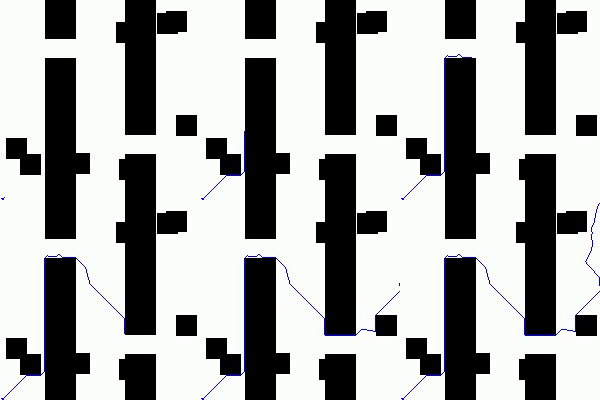
Unsupervised Path Regression Networks (IROS 2021)
We train learning-based planners from scene geometry rather than optimal trajectories. The method works well as a pre-training step in high-dimensional planning problems.
Emulating and Analysing the Sensitivity of Molecular Diffusion
We used multi-fidelity deep Gaussian processes to emulate molecular diffusion, making simulation faster while preserving expected physical behavior under Sobol sensitivity analysis.